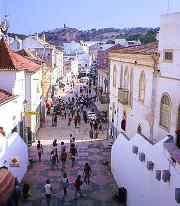
Albufeira is the Algarve's most popular resort destination, famed for its stunning beaches, vibrant nightlife, and a beautifully preserved old town that retains echoes of its Moorish past.
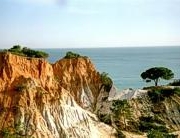
First and foremost, Albufeira is renowned for its beaches — countless shades and tones of golden sand sheltered by colourful cliffs. This is a place where people live to the rhythm of a great holiday destination: sunbathing during the day, then flocking at sunset to enjoy the restaurants, bars and discos that enliven the night-time hours.
Just a few miles inland and everything changes. The green countryside is dotted with almond, fig, orange and pine trees, and decorated chimneys stand out against the ochre of tiled roofs. Bucolic villages invite you to experience a way of life rooted in the tranquility of nature.
History
In Roman times the town was known as Baltum, later changed by the Moors to Al-Buhera (meaning "Castle-on-the-Sea"). During the Moors' 8th century occupation, the town became an important trading port.
In 1532 and again in 1755 the town was badly hit by earthquakes. In the latter disaster, 227 people perished under the falling roof of the parish church. During the "War of the Miguels" the town was besieged and set ablaze. The destroyed town consequently suffered a very long period of poverty and has only really recovered with the boom of tourism in recent decades.
The Historic Town
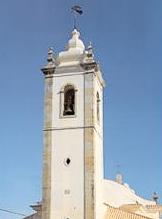
The Bell Tower (Torre Sineira)
Constructed in 1869, this tower is part of the Parish Church. Access to the top is via a 28-metre stairway, topped with an eight-bell carillon.
The Clock Tower (Torre do Relógio)
The symbol of the city, found at Rua Bernardino de Sousa. During the 19th century this tower was adorned with an iron crown which holds the bell that rings out the hours and is illuminated during festivals.
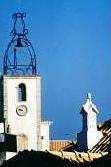
Misericórdia Chapel
This chapel, a former Arab mosque, is located at Rua Henrique Calado and was the Governors' chapel. In 1499 it was restored and named the "Capela da Misericórdia". Damaged by the 1755 earthquake, the reconstruction restored the original body and main doorway to its Gothic style. Inside is a carved wooden altarpiece supporting an image of Our Lady of the Visitation and the tomb of Rui Dias, believed to have been the Governor of the Castle.
The Parish Church (Igreja Matriz)
Located on Rua da Igreja Nova, dating from the 18th century (1782). Blessed on 15th July 1800 by the Bishop of the Algarve, Dom Francisco Gomes de Avelar, this edifice replaced the former Parish Church which collapsed during the 1755 earthquake.
The church is Neo-classical in style, built with one nave. It has 4 lateral chapels, a baptismal chapel, choir, two pulpits and two lateral rooms dedicated to the Holy Souls of the Bishop S. Luís, Our Lady of Fátima and the Sacred Heart of Jesus. A magnificent painting by the local artist Samora Barros decorates the high altar, serving as background for the image of Our Lady of the Conception, patron saint of Albufeira.
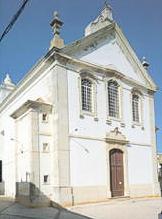
Santa Ana Doorway (Porta de Sant'Ana)
One of the three castle doorways, named for providing access to the Chapel of Santa Ana which disappeared in the 1755 earthquake. Worship to Sant'Ana continued at the current chapel built at the end of the 18th century.
Santa Ana Church (Igreja de Sant'Ana)
This temple was built in the 18th century and is located in Largo Jacinto d'Ayet square. The main chapel shows a wooden altarpiece believed to have been made by masters Francisco Xavier Guedelha and João Baptista. Also notable is an altarpiece holding Our Lady of Pain and an image of the Crucifixion of Christ sculpted in wood.
S. Sebastião Church (Igreja de São Sebastião)
Built in the mid-18th century, located in Miguel Bombarda square. Its architectural style is of popular inspiration. From the outside one may see the dome and two doorways — the sides adorned with stone masonry in Manueline style, the main ornamentation an excellent example of Baroque style.
The interior is composed of only one nave. One may also behold an 18th-century wooden altarpiece, 6 images of saints in wood by an unknown artist, and an image carved in stone perhaps from the 16th century which belonged to the early Chapel of Nª Srª da Piedade.
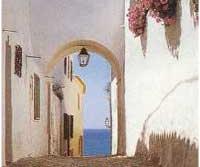
Castle Walls (Muralha do Castelo)
Only the remains of one tower survive, located at Rua Joaquim Pedro Samora where the North Gateway (or Beach Gateway) would have been situated.
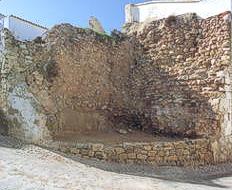
Town Hall (Câmara Municipal)
The construction date is unknown but believed to have originated during Medieval times. The building was severely damaged by the 1755 earthquake and by fire during the liberal wars and guerrilla invasion by Remexido. Over the main doorway one may see the Azevedo coat-of-arms representing the cross of the Order of Aviz and an owl in flight, the head of the family being the Governor of Albufeira Castle.
The Old Inn Building
Found at Rua Henrique Calado, this is one of the few constructions which survived the 1755 earthquake. Many travellers and beggars would shelter and stay here.
Xorino Cave
This geological formation under the cliff served as a shelter for fugitive Moors during the Christian Reconquest of Albufeira.
São Vicente de Albufeira
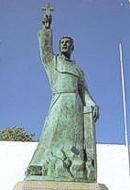
This monument in honour of Friar Vicente de Santo António is located in Largo Jacinto d'Ayet square. Saint Vicente was born in 1590 in the Town of Albufeira and his mother offered him to Our Lady of Orada upon his baptism.
The death of his parents led him into the priesthood, after which he left for Mexico where he was accepted into the Order of Santo Agostinho. After many difficulties he finally managed to fulfill his dream — to preach the Christian faith in Japan. He was imprisoned for two years during which he was tortured to force him to give up his Christian beliefs. Since he did not recant, he was placed in a cell and burned at the stake. On 3rd September 1632, he died while lifting a crucifix and calling out "Long live the Faith of Jesus Christ".
Museums
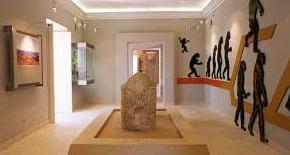
Municipal Archaeological Museum
Located in the old part of Albufeira in the former Town Hall building, with its typical southern Portugal architecture. Its exhibits tell the history of the region from prehistoric, Roman, Islamic to the present day. The collection was assembled by Father José Manuel Semedo de Azevedo.
Arquivo Histórico e Biblioteca Municipal
Contains unique examples of manuscripts describing the historical events of the region from remote times.
The Municipality
Guia
A village with a long history which has grown rapidly in recent decades.
Main Church: A country church built in the 17th century, containing a simply carved high altar and statues from the 17th and 18th centuries.
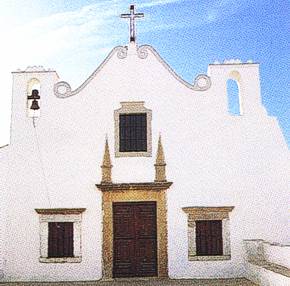
Hermitage of Nossa Senhora da Guia (Our Lady of the Good Journey): A typical Baroque building with a lively facade (16th/17th centuries). Not far away, at the mouth of the Espiche creek, is Lagoa dos Salgados — with its typical lakeland vegetation, an excellent spot for watching migratory birds.
Paderne
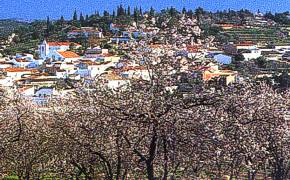
Paderne has its origins in the remote past and may have begun with settlers from the nearby castle. Located on a gentle hill, its old white houses stand out from the surrounding countryside. One house has an interesting decorated chimney from the 18th century.
Main Church: The original building in Manueline style (16th century) has been altered by successive reconstructions. The interior has three naves. The arch of the main chapel is decorated with human figures and has monogrammed columns.
Paderne Castle: Situated just over a mile from the village, built on a spur of rock around which flows the Quarteira creek. It is Arab in origin and was inhabited until the 14th century. Inside are the ruins of the Hermitage of Nossa Senhora da Assunção.
Beaches
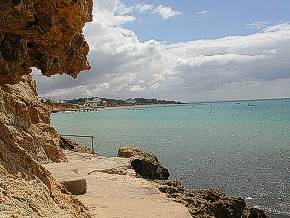
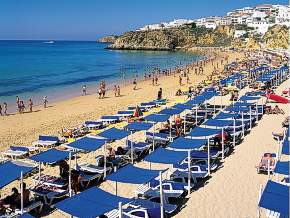
Albufeira boasts beaches where the sand is fine and the sea a turquoise blue, sheltered by cliffs painted with a whimsical palette of natural hues. It is for its beaches that Albufeira is internationally renowned — all different, yet all equally enchanting.
- Praia da Galé: An expanse of sand stretching for miles between cliffs. Well equipped with tourist facilities.
- Praia do Castelo: A cove protected by rock formations. Great natural beauty.
- Praia da Coelha: A small beach between colourful cliffs.
- Praia de São Rafael & Vigia: Beaches of great beauty separated by rocks. Tourist facilities. Nearby Ponte Pequena and Ninho das Andorinhas are fascinating rock formations.
- Praia da Baleeira: A broad crescent of sand opposite Albufeira.
- Albufeira Beach: A long strip of sand with the city surrounding it like an amphitheatre, made up of three beaches: Peneco, Pescadores and Inatel.
- Oura, Balaia, Maria Luísa & Olhos d'Água: A series of beaches each sheltered by colourful cliffs. Tourist and sports facilities.
- Praia da Falésia: Endless miles of beaches fringed by green pines and the many reddish colours of surrounding cliffs.
Festivals
- 4th February: Feira do Pau Roxo
- July: Feira de Artesanato (Handicraft Fair)
- August: Feira de Nossa Senhora da Orada
- August: Feira de Frango (Chicken Festival)
- 28th & 29th August: Feira de Nossa Senhora da Guia
Practical Information
Location: Albufeira is located in the central Algarve, approximately 39 km from Faro. The municipality covers 14,800 hectares with a population of around 40,000, divided into five parishes: Albufeira, Ferreiras, Guia, Olhos d'Água and Paderne.
Climate: Distinctly Mediterranean — hot dry summers and mild winters with reduced rainfall, especially between October and March. The average annual temperature is around 17.5°C.
Getting There: Faro Airport is the nearest international airport, approximately 30 minutes by car. Regular bus services connect Albufeira with other Algarve towns and Lisbon.