About Aveiro
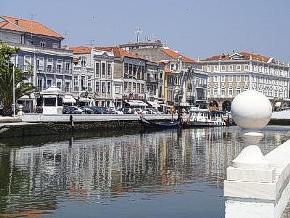
Known as the Venice of Portugal, Aveiro is surrounded by salt-flats, beaches and lagoons, dominated by the Central Canal running through town.
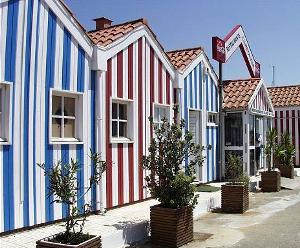
Once a major sea port, Aveiro lies in a region of valleys cut by mountains and fertile lagoon plains. The city is crossed by canals which give it quite an individual character. In the old quarter, tourists can see the quaint whitewashed houses of fishermen and visit the Mercado do Peixe early in the morning - an auction of fish caught during the night.
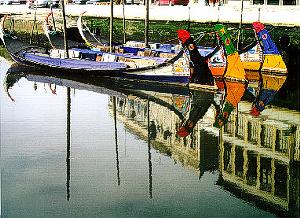
Of all the boats seen in the area, the moliceiro is the most elegant - perfectly lined, painted with bright colours and with often ingenious and humorous decorations. These traditional boats were originally used to harvest seaweed (molico) from the lagoon for fertilizer.
What to See
Churches and Religious Heritage
Se Cathedral of Aveiro
The Church of Saint Dominic, now the Se Catedral de Aveiro, was founded in 1423 and remodelled in the 16th and 17th centuries. Works executed in 1719 greatly altered its facade. It features examples of several religious architectural styles: mannerist side chapels, baroque high choir, vaults and cross, and modernist transept and master chapel.
Church of St. John the Evangelist
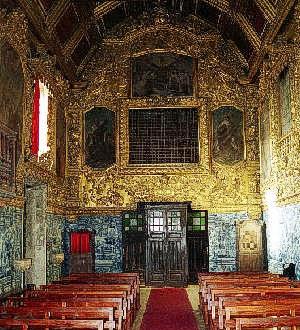
Also known as Igreja das Carmelitas, this church belonged to the Carmelite convent of the same name. Founded in 1657, it is a classic example of religious architecture from the mannerist and baroque periods, with a longitudinal plan, mannerist architectural structure, and internal baroque decoration in golden woodwork and tiles.
Igreja do Carmo
Constructed in 1613, inside you can admire two altars from the 17th and 18th centuries, sculptures of artistic value, and screens representing scenes of the Passion.
Igreja de S. Goncalos
A hexagonal chapel constructed during the first quarter of the 18th century. The cult of S. Goncalo represents a peculiar devotion for the people of Aveiro - it is traditional to throw dry cakes to the crowd as fulfilment of promises.
Museums
Museum of Aveiro
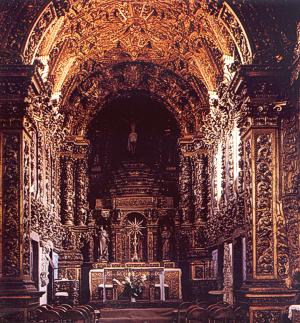
Established in 1911, the Museum of Aveiro occupies the building of the old Convent of Jesus. It conserves several spaces from the previous conventual experience within its circuit of visit. The collection originates from the Convent of Jesus and other religious houses, encompassing painting, sculpture, paraments, tiles, goldsmithery, furniture, and ceramics - with particular focus on the baroque period. It also possesses documents from the 15th to 19th centuries.
Modern Aveiro
University of Aveiro
Established in 1972, the University of Aveiro has become an institution of great national and international prestige, known particularly for its modern campus architecture.
Railway Station
The historic railway station is decorated with beautiful azulejo panels depicting regional scenes and traditions.
Beaches
Praia de Sao Jacinto
The fine beach of Sao Jacinto lies close to woodland and the Sao Jacinto Dunes Natural Reserve, with well-preserved dunes and varied fauna and flora. Access is by ferry from Aveiro across the lagoon.
Local Gastronomy
Those who appreciate good food can taste the delicious eel stew and a variety of sea and lagoon fish soups. But Aveiro is especially known for its sweets: the most famous is ovos moles (soft eggs) - sweetened egg yolk in candied casings shaped like fish or barrels. This traditional confection has Protected Geographical Indication status and is a must-try for any visitor.
Getting There
By Train
Regular trains from Lisbon and Porto. Aveiro is on the main Lisbon-Porto line with services approximately every hour.
By Car
Aveiro is located on the A1 motorway, approximately 250 km north of Lisbon and 70 km south of Porto.