About Loulé
Loulé: the racy, cosmopolitan lifestyle of the world's leading tourist centres. A long ribbon of fine, golden sand tucked between the blue of the sea and the bold ochre of the cliffs. The splendour of tiles in a chapel that is itself a work of art.
The changing greens of the orchards and the woods of the hills. An endless variety of decorated chimneys, carefully wrought in a filigree of whitewashed stone and art. Wide open spaces where it is possible to rediscover the meaning of solitude and listen to the silence of nature. With all this and more, Loulé municipality is a place of sunshine and colour, fun and excitement.
The City of Loulé
The evocative battlements of a medieval castle. A maze of narrow, white streets where craftsmen carry on age-old traditions. The vertical lines of the minaret of an ancient mosque. The broad horizons of a revered sanctuary set high on a hill. Just a few facets of Loulé, a town of charming contrasts.
Castle
Located on the spur of a hill which was once the site of the town, it used to boast a series of defensive walls approximately 940 metres in length. Three towers, a turret and a stretch of ramparts with a walkway along the top define the defensive structure. Inside lies the 'alcaidaria' - where the commander of the castle lived - which was possibly built in the 14th century and rebuilt in the 18th century. The castle was visited by King Pedro I in 1359, King Afonso V in 1458 (after the conquest of Alcácer Ceguer in North Africa), and King Sebastian in 1573. In the courtyard there is a well, some medieval blocks and the arch of the old gateway leading to the town.
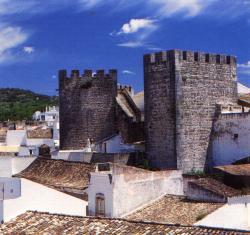
Defensive Walls
All that remains of the medieval fortifications are 2 towers and a few stretches of wall.
Main Church of São Clemente
Probably raised on the site of the mosque, this building dates from the third quarter of the 13th century. Specialists say it reflects the southern gothic style of architecture. It has undergone a number of alterations, above all in the 16th and 18th centuries. It has an ogival entrance archway spanned by a rosette and a circular window. The side entrance is gothic. The bell tower began life as a Moorish minaret, from which the Muslim faithful were summoned to prayer, and displays late baroque ornamentation.
The interior consists of three naves, with ogival arches supported by capitals decorated with carved foliage which suggests they are perhaps the work of Moorish craftsmen. The columns are of varying heights and appear to have been built using materials from earlier Roman or Moorish structures.
Church of Misericórdia
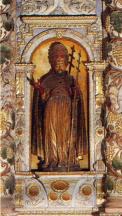
This is a 16th century building with a radiate Manueline entrance, with carved ropes, finished off by two twisted, piled up pinnacles. Opposite the doorway stands a cross from the same period with statues of Christ and Our Lady. The carved altarpiece in the main chapel is a simple piece of 18th century work but it contains two 16th century statues, one of which is of alabaster and came originally from the Graça Monastery.
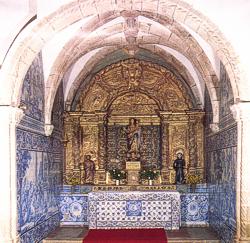
Church of São Francisco
The exterior of the church is of little architectural merit. An interesting feature of the fine carved and gilded retable on the main altar (18th century) is the highly decorative tabernacle in the form of a pelican.
Hermitage of Nossa Senhora da Conceição
This unassuming church dates from the second half of the 17th century and was built on the site of a 16th century oratory, backing onto one of the gates in the city walls. Inside it has fine tile decoration depicting scenes from the life of the Virgin and a richly decorated carved and gilded retable. On the ceiling there is a panel depicting the Virgin by the Algarvean painter Rasquinho (19th century).
Monastery of Espírito Santo
Built in the 17th and 18th centuries, the structure suffered major damage in the earthquake of 1755. Expropriated in the 19th century, it has recently been turned into a cultural venue containing the Municipal Art Gallery and a small collection of exhibits relating to the textile industry in Loulé municipality. Among the objects to be seen is an 'orphans' wheel' - a device which allowed unwanted babies to be left anonymously to the charity of the religious order.
Municipal Museum
The museum is housed in the former commander's residence in the castle. Its collection includes archaeological, ethnographic and industrial objects from the municipality. The commander's residence is also home to the Municipal Historical Archive.
Hermitage of Nossa Senhora da Piedade (Mãe Soberana)
Situated on a small hill, this country church affords magnificent views of the surrounding fields and the sea. The current structure is 18th century and was built on the site of an older building. The main altar has a carved 18th century retable, while the statue of the patroness, who wears a dramatic expression on her face, is from the 17th century. On one of the walls is a cross made of tiles painted with figures which dates back to the 18th century. The centuries-old cult of the Sovereign Mother, which is strong in Loulé and across a great swathe of the Algarve, reaches its high point each year on the second Sunday after Easter, when a group of men carry her effigy at a run up the steep path leading to the hermitage.
Monastery of Graça
All that remains of the original monastery is the gothic doorway to the church, which has capitals decorated with vegetable motifs. The damaged gable bears a symbolic star consisting of two crossed triangles that has yet to be deciphered.
Loulé's Salt Mines
Running beneath Loulé at depths of between 230 and 270 metres are several kilometres of galleries where rock salt of great purity (90% pure) is mined. An interesting facet of Loulé's economy that for the time being is not on the tourist trail.
Sightseeing in the Municipality
Querença
Savour the atmosphere of a traditional Algarvean village of white houses and modest gardens.
Main Church - With its origins in the 16th century, this church has undergone subsequent alterations. The facade has a simply decorated Manueline doorway, and the side entrance is from the same period. The main and side chapels have carved and gilded retables (18th century). In the square in front of the church stands an interesting cross mounted on a limestone boulder.
Fonte Benemola Classified Site - There are nature trails for walkers. Within the park are a number of caves containing archaeological remains. The local fauna includes otters, a wide variety of birds and a few colonies of bats. On the approach road is the Cerro dos Negros viewpoint, which looks out over a broad sweep of coastline.
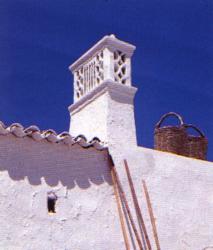
Salir
The white houses of the village are scattered higgledy-piggledy on the hillside around the ruins of the castle. Its narrow streets are an alluring mix of bright flowerpots, whitewashed walls and peace and quiet.
Main Church - Although of little architectural interest, this church does contain one small treasure: an illuminated papal bull on parchment dated 1550. It also boasts carved and gilded 18th century retables and statues from the 17th and 18th centuries.
Castle - The fact that it does not have an 'alcáçova' (house of the castle commander) suggests that the castle was built in the 12th/13th centuries to defend the peasants who worked in the fields from Christian attack. Captured by the Knights of the Order of Santiago after the fall of Tavira, it was here that the Master of the Order, Paio Peres Correia, awaited the arrival of the army of King Afonso III before going on to seize Faro (1249-1250). Its ramparts are built of taipa and are one of only a few surviving examples of Moorish fortifications in Portugal. The castle is an excellent vantage point. To the north it looks out over the forbidding ranges of the Serra, while seaward the view is of more gentle, verdant hills.
Rocha da Pena Classified Site - A limestone massif with steeply scarped sides, Rocha da Pena rises to a height of 479 metres. There is a panoramic view from its summit which takes in the sea.
Alte
Some consider Alte, which has existed since the period of the Roman occupation, to be the village most typical of the Algarve. With their whitewashed houses, windows and facades edged with colourful borders, ornate chimneys and pervasive air of tranquillity, the streets of Alte's historic centre have retained much of their original charm. The area around the church is a delightful snapshot of the real Algarve.
Main Church - Built in the 13th century by the wife of the second lord of Alte to give thanks for his safe return from the eighth crusade to the Holy Land, the church has been modified on a number of occasions since, above all in the 16th and 18th centuries. The interior consists of three naves. The walls and vaults are decorated with 18th century tiles. The chapel of São Sebastião contains notable polychrome tiles made in Seville which date from the end of the 16th century.
Chapel of São Luís - Built at the beginning of the 15th century, it was subsequently altered until it attained its current appearance, that of a country church in the taste of the 18th century. The interior is plain; its most curious feature is a series of four paintings depicting the life of St. Louis (18th century).
Fonte Pequena and Fonte Grande - For centuries these two sources were a meeting place for the women of the village who would fill their water pitchers and do their washing. Tables and stone benches have now been installed in the cool shade of the overarching trees, making this an ideal spot for having a picnic or just lazing around.
Ribeira de Alte and its mills - The waters of the Fonte Pequena and Fonte Grande, which are the source of the Alte river, once turned the wheels of the village's nine mills. Most have since fallen into ruins, but the Moinho da Abóbada mill, which is known to date back to the 13th century, is still to be seen.
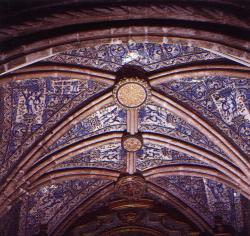
Almancil - Chapel of São Lourenço dos Matos
The chapel and the area that surrounds it, which includes an art gallery housed in carefully restored old buildings, retain much of the character and charm of the Algarve of centuries past.
The occurrence of a miracle in 1722 when the locals were searching for water prompted the construction of the chapel. The architecture is baroque, with an elegant cupola and tiled panels set over the main entrance and to the rear of the main chapel.
The tiles on the walls, ceiling vaults and cupola were made in Lisbon in 1730 and recount the life of São Lourenço (St. Lawrence). Together they form one of the most outstanding decorative ensembles in Portugal and earn the chapel a unique place in art history. Particularly worthy of note is the harmonious way the tiles fit in with the carved and gilded retable on the main altar and the decorative detail on the triumphal arch and at the base of the cupola.
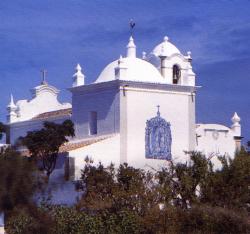
Barranco do Velho
A beautiful church, built in 1944 in the Algarvean rustic style, looks out from the top of a hill. The churchyard is one of the most marvellous viewpoints in the Algarve and from it can be seen an endless vista of hills covered with cork oaks, stretching away almost as far as Loulé, Salir and Alte. In the nearby ranges of hills are to be found picturesque thatched stone houses, round in shape, that are used as barns these days but which recall the dwellings of the peoples who lived in the region in prehistoric times.
Beaches
Thanks to its golden sands and sunny climate the whole of the coast has become a major centre for beach holidays and includes some of the best tourist facilities in the Algarve.
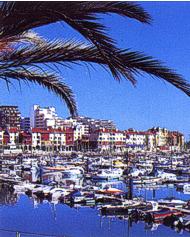
Vilamoura - Vilamoura's attractive beach is complemented by a tourist development that ranks with the biggest and most prestigious in Europe.
Quarteira - Once a simple fishing village, Quarteira has become a cosmopolitan tourist centre. Its past identity can be glimpsed in a 17th century church and a few houses decorated with coloured borders.
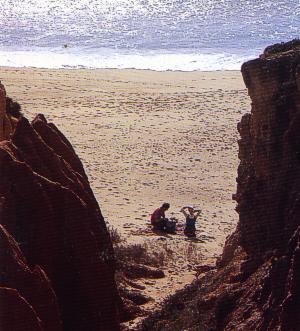
Vale do Lobo - A beach that owes its unique beauty to its ochre and ruby cliffs. It is surrounded by a high quality tourist complex.
Garrão - Long beach edged with brightly coloured cliffs, with facilities for tourists.
Quinta do Lago - A long beach with pedestrian access by way of a bridge over the Ria Formosa. It is the site of a top-level international holiday complex.
Golf
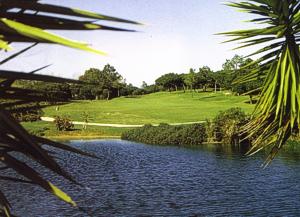
The Loulé municipality is home to some of the finest golf courses in Europe:
Ocean Course - Part of the Vale do Lobo tourist resort, located near the sea.
Royal Course - Famous for its Par 3 hole, which requires a shot of more than 200 metres over three spectacular cliffs.
Pinheiros Altos - A highly original course with two sets of nine holes that have completely opposing characteristics.
Quinta do Lago South - Has played host to seven Portuguese Opens.
Quinta do Lago North (Ria Formosa) - Great par 5 holes requiring power and accuracy.
San Lorenzo - Eighteen widely-ranging holes run past pine trees, lakes and beaches beside the Atlantic Ocean.
Vila Sol - The great variety of trees adds special charm to a course blessed with excellent facilities.
Vilamoura courses - Including Laguna, Millennium, Old Course and Pinhal, offering challenges for every level of player.
Practical Information
Getting There
By Car: Loulé is approximately 16 km northwest of Faro via the N125 or A22 motorway.
By Bus: Regular bus services connect Loulé with Faro and other Algarve towns.
By Train: The nearest station is at Loulé, on the Algarve railway line.
Markets
The Loulé Municipal Market is one of the most vibrant in the Algarve, with fresh produce, fish, and local crafts. A gypsy market is held every Saturday morning.
Festivals
The Mãe Soberana festival (second Sunday after Easter) is one of the largest religious celebrations in the Algarve. The Loulé Carnival is also a major event, with parades and festivities.