About Monchique
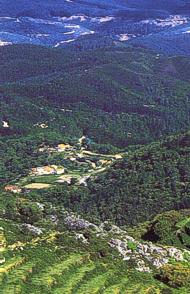
'Green, how I love you green'. The poet could have been writing of the wooded slopes of Monchique, for after the heat of the Algarve beaches it is the coolness of the hills that is most striking.
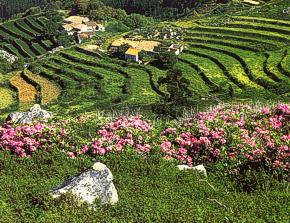
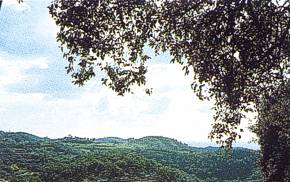
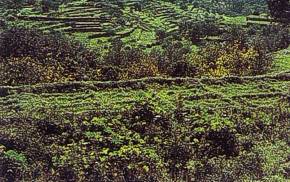
These landscapes weave a spell of reverie and spur the visitor to stride out in search of unglimpsed horizons that end only in the sea. Here rivers gurgle between rocks, while white dots of houses and the slopes cut into terraces, planted with fruit trees and vegetable plots.
History
Monchique municipality enters the annals of history with the arrival at Caldas de Monchique of Roman settlers drawn by the curative powers of the local waters. The local population grew slowly over the years and by the 16th century Monchique was big enough to justify a visit from King Sebastian (1554-1578) whose intention was to grant it the status of a town.
Monchique's prosperity was founded on weaving wool and linen to make the sturdy fabrics worn in times gone by and on other activities that included felling and working the wood of the local chestnut trees. It earned its civic charter in 1773. The economic changes wrought by industrialisation signalled the end of local textile production and other manufactures. Today Monchique is a pretty town with a diversified economy based on tourism and crafts.
Places of Interest
Caldas de Monchique
Developed in Roman times as a spa. Here a visitor can try the curing elements of the sulphur-smelling hot spring water that emerges at a constant temperature of 32°C. There are two further hot spring sites, one of which is to the south of Picota hidden in a valley. Its name is Fonte Santa and it is rumoured to have special healing properties. Some people make annual visits and centuries ago it was recorded as being visited by both the King of Portugal and the King of Italy.
A pretty square shaded by trees and flanked by attractive buildings dating from the end of the 19th and beginning of the 20th centuries epitomises the town's calm and relaxing atmosphere.
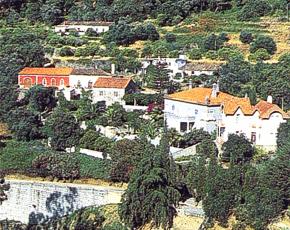
Alferce
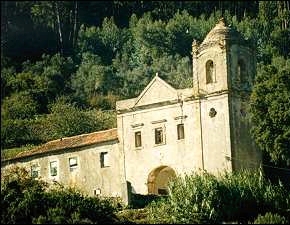
This charming village is made up of houses built in the style typical of the Algarvean countryside. The medieval origins of the village church are evident in its ogival porch, its triumphal arch and the ribbed vault in its main chapel. Nearby on Cerro do Castelo stand the ruins of a fortification with concentric walls that was probably built by the Romans.
Marmelete
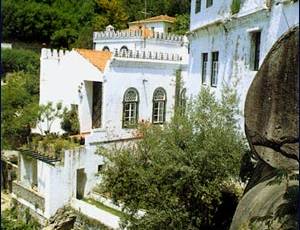
The low white houses of the Algarvean hills stand out from a palette of warm browns and ochres. The bucolic country chapel of Santo António (St. Anthony) stands on a small elevation and affords fine views of the surrounding countryside.
A Walk in the Monchique Hills
Take the road up to Monchique and at almost every turn you encounter a stunning panorama of sea and mountains. For the broadest vistas, continue as far as Fóia which at 903 meters is the highest point in the Algarve. From there the view stretches away on one side as far as Cape St. Vincent and north to the Serra da Arrábida near Lisbon, and on the other to Faro and a vast semi-circle of hills.
Picota is 774 meters high, but steeper, and has broad and perhaps even more beautiful views that take in a long sweep of the Algarve and the sea.
There are many routes to choose from. The road to Marmelete traverses a landscape of terraced slopes, fertile valleys and orchards, passing by the gigantic scar of the 'foiaite' quarries at Nave. The narrow tracks that wind into the Serra lead you to places like Romeiras, settled like a sunken ship beneath a sea of mountains, or surprise you with the sudden apparition of lakes like the one formed by the dam at Bravura.
The road that leads to the Alentejo passes through some of the most beautiful countryside in the Algarve, a bucolic region blessed with leafy woods and groves of fruit trees watered by fast flowing streams.
It is worth taking the turn off to Barranco dos Pisões, evoking the old water-driven machinery that was once used to beat the woollen cloth and blankets produced locally. Abandoned water wheels are another sign of the region's bygone economic importance. But the most spectacular route is perhaps the road down from Alferce to Fornalha and Monchicão through the mountains.
Monchique Town
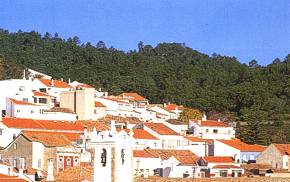
Monchique is best visited on foot. A walk through the steep streets of the town centre is rewarded with views of magnificent hills, glimpsed between houses, and moments of sunlit calm in unsuspected corners. It leaves a memory of a hill town with a history and character all its own and instils a strong desire to return.
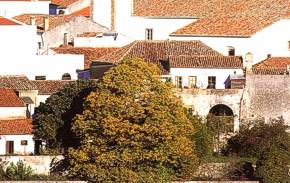
Historical Centre - The houses of Monchique display many of the traditional features of Algarve architecture - white walls, carved stonework, bands of colour around doors and windows - but their saia (literally skirt) chimneys are quite distinct from those found on the coast. The narrow streets that wind up the steep hillside, revealing fresh views of verdant hills at every turn, lend the town a certain exoticism to which camellias, hydrangeas and fruit trees add a fragrant suggestion of gardens and orchards.
Main Church
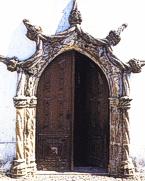
Raised in the 15th/16th centuries, the church was rebuilt following the earthquake of 1755. The main entrance is in the Manueline style decorated with cogiolos at its five corners and masks between its columns. The side doorways, which are plainer, date from the same period. The interior is made up of three naves. The capitals of the columns are fashioned in the shape of twisted ropes, repeating the decorative theme of the main entrance.
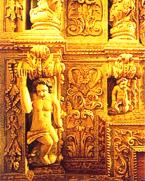
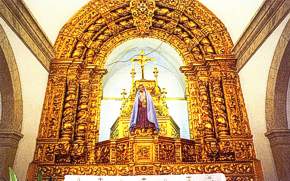
In the main chapel is a carved and gilded retable (18th century) that is quite distinctive in design: on the arch are two angels holding up the sun and the moon, while a curious pair of atlantes support the ensemble as a whole. There is an interesting tabernacle in the form of a miniature church. The statue of Nossa Senhora da Conceição is attributed to the sculptor Machado de Castro.
The Capela do Santíssimo (Chapel of the Most Holy) has a small collection of 17th century tiles. The church also houses a number of ceremonial objects which once belonged to the monastery of Nossa Senhora do Desterro (Our Lady of Exile).
Church of São Sebastião
Modest looking from the outside, this church contains a statue of Nossa Senhora do Desterro (Our Lady of Exile) which is highly expressive of sorrow. An accomplished work of 17th century sculpture, it came from the former Franciscan monastery. The baldaquin and the whimsical columns which are incorporated in the retable around the altar possibly share the same origin.
Misericórdia Church
The carvings on the altar, pulpit and baldaquin in this church are its chief artistic attractions, together with two large 18th century canvasses and the panels carried in religious processions.
Senhor dos Passos Hermitage
This small chapel, topped with two bell towers, evinces the unassuming style of popular architecture. Inside there is a life-size statue of Christ.
Handicrafts
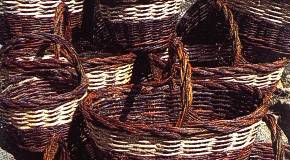
The craftsmen and women of Monchique still make wicker baskets, wooden spoons, knives and other kitchenware, cloths and other linen items as their predecessors did for generations before them. Scissor chairs, so-called because of the way they fold shut, are possibly an invention left behind by the Romans, and are to be found in all sizes. Modern craft trends are reflected in dried flower arrangements, tapestry pictures and sculptures made of tree branches.
Gastronomy
Dishes made with rice and beans or chestnuts are not to be missed. Equally tasty are the many recipes based on pork which also finds its way into a wide variety of delicious home made sausages and blood sausages, including 'farinheiras' and 'mólhos'. Another local delicacy is the ham cured using methods centuries old, its smoky, nutty flavour is unforgettable.
Honey is an ingredient common to nearly all the cakes and desserts. The nectar gleamed from the many different types of wild flower makes a fragrant, complex honey that has long had a reputation for quality. Indeed bees have been kept commercially since the 16th century.
At the end of a meal nothing goes down like a glass of 'medronho', the heady spirit made in copper stills from the fruits of the arbutus tree.