About Porto
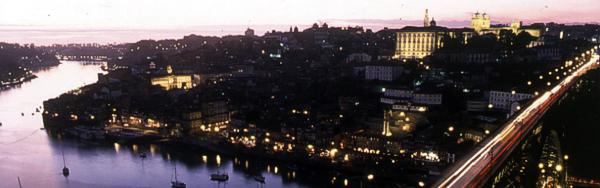
Portugal's second largest city, Porto faces the famous port wine lodges across the River Douro, combining ancient pride with modern commerce in a thriving urban centre.
Although its ancient roots have been preserved with pride, a modern and lively commerce makes Porto a thriving city. Its traditional importance as an industrial centre does not diminish the charm and character of its old quarters or even of the newer busy avenues, shopping centres and quiet residential blocks.
The Cathedral area deserves exploration, with its various monuments including the Renaissance church of Santa Clara and the densely populated quarter of Barredo, which appears unchanged since medieval times. The riverside quarter of Ribeira is delightful, with narrow streets, typical houses and picturesque lifestyle - recently restored and now including fashionable restaurants and bars.
Sightseeing
Churches and Religious Architecture
Se Cathedral
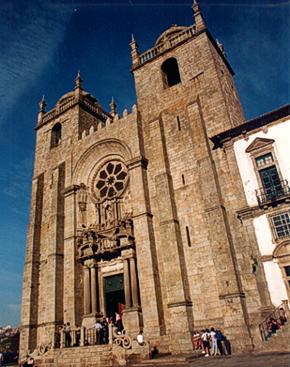
Built in the 12th century in Romanesque style, the cathedral was later modified several times. Inside, admire the paintings by Nicolau Nasoni, the silver altarpiece of the Holy Sacrament, the Joao Gordo ("Fat John") Chapel and the cloister. At the southern tower, two standard measures are engraved in the stone - vestiges of the Medieval fair held in the Cathedral grounds.
Igreja e Torre dos Clerigos
A monument of Baroque style built between 1754 and 1763 by Italian architect Nicolau Nasoni. The Torre dos Clerigos became the emblem of Porto. From the top of the tower, six floors and 76 metres high after climbing 225 stairs, visitors enjoy dazzling views over the city, the River Douro and its estuary.
Igreja do Carmo
Situated close to the Clerigos Tower, the Igreja do Carmo is a remarkable construction featuring an amazing panel of azulejo tiles on an exterior wall, depicting scenes describing the foundation of the Carmelite Order.
Igreja de Cedofeita
A peculiar church in Portuguese Romanesque architecture - the only building with a single nave covered by a stone vault, which explains the massive exterior buttresses. It comprises a nave and quadrangular top separated by a crossing with calcareous capitals.
Igreja de Sao Francisco
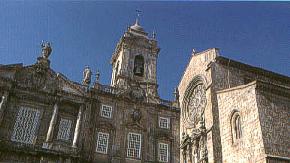
One of the few remaining medieval buildings in Porto and the only Gothic church in the city. Part of a Franciscan convent, construction lasted from the late 14th to early 15th century. In the 17th and 18th centuries, the interior was completely covered with gilt wood carvings, forming a golden box - one of the most beautiful Baroque interiors in Portugal.
Igreja de Santo Ildefonso
Constructed from 1709 and completed in 1739, this proto-baroque church features steeple towers topped by fantasy spheres and frontons. The walls are decorated with tiles by Jorge Colaco (1932), depicting scenes from the life of St. Ildefonso and allegories from the Eucharist.
Historic Landmarks
Estacao de Sao Bento
Built on the site of an ancient convent and completed in 1916, this railway station now serves regional trains. Inside, immense panels of azulejo tiles created by Jorge Colaco reproduce historical scenes, adding rare artistic beauty to the station.
Palacio da Bolsa (Stock Exchange)
An 18th century Baroque construction by Nicolau Nasoni. Notable for its interior decorated with Baroque-rococo gilt carvings, the polychromatic retable by Manuel Porto, and the impressive Arabian Hall inspired by the Alhambra.
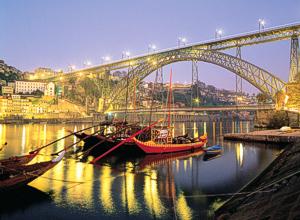
Ponte D. Luis I
Designed by engineer Teofilo Seyrig (who had worked with Eiffel on the earlier Ponte D. Maria Pia), construction began in 1881 and the bridge was inaugurated on 31 October 1886. The iconic double-deck iron arch spans 172 metres with an arch height of 44.6 metres.
Ribeira District
Ribeira
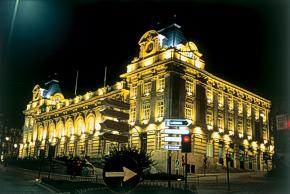
The genuine city is visible at the quarter of Ribeira ("riverbank"), right by the Douro. Narrow and winding streets, dark arcades, typical houses with colourful facades set in a place marked by history, full of contrasts and curious characteristics. At night, Ribeira comes alive as one of the most sought-after areas due to numerous restaurants, esplanades and nightlife venues. The area is a UNESCO World Heritage Site.
Museums
Museu do Vinho do Porto
Located in an 18th century warehouse where wines of Companhia Geral da Agricultura das Vinhas do Alto Douro were once stored. The museum is an information centre about Port wine, exploring the commercial history of the city.
Casa do Infante
The "House of the Prince" or Old Custom House now houses the Municipal Archive. Archaeological research uncovered an important Roman palace and buildings from the 14th century onwards. A site museum displays the finds. Traditionally believed to be the birthplace of Prince Henry the Navigator.
Museu Nacional Soares dos Reis
Portugal's first art museum, born in 1833 when King D. Pedro IV established a Paintings and Prints Museum. Located since 1940 in the 18th century Palacio dos Carrancas, it preserves artistic heritage from extinct convents.
Museu Romantico
The Romantic Museum of Quinta da Macieirinha reproduces the interior of a rich 19th century dwelling. Charles Albert, King of Piedmont and Sardinia, spent his last days in exile here, dying on 28 July 1849.
Port Wine
Porto gave its name to Portugal's most famous export - Port wine. Across the river in Vila Nova de Gaia, the historic wine lodges offer tours and tastings of this fortified wine that has been produced in the Douro Valley for centuries.
The tradition dates back to the 17th century when English merchants began shipping wine from Portugal. To preserve the wine during long sea voyages, brandy was added - creating the distinctive fortified wine we know today.
Getting There
By Air
Francisco Sa Carneiro Airport is located 11km northwest of the city, with metro connections to the centre.
By Train
High-speed trains connect Porto to Lisbon in about 2.5 hours. Campanha station handles long-distance trains; Sao Bento serves regional routes.
