About Silves
The dark red of mighty castle walls that loom over the city and the surrounding countryside. The interplay of stone and light on gothic architecture. Vestiges of the Moorish presence in the city's history. Streets of white houses that reflect the sun and the blue sky. Herein lies the appeal of Silves where the past merges with the present.
The deep green foliage of orange trees in fertile valleys. The blue sea and the fast-paced life of an international seaside resort. The picturesque charm of houses surrounded by almond and carob trees. The broad sweep of hills that are a haven for ramblers and nature lovers. These are among the attractions of Silves district, a holiday destination where it is a pleasure simply to be alive.
History
The presence of man during the Palaeolithic period is confirmed by archaeological sites. The whole area of what is now Silves municipality was inhabited during the Neolithic period and the Bronze and Iron Ages, as borne out by numerous archaeological finds. Particularly impressive are the abundant megalithic monuments and menhirs carved out of the region's red sandstone and limestone.
The Arade river has since time immemorial been the route to the interior favoured by vessels of the Mediterranean peoples - Phoenicians, Greeks and Carthaginians - who were drawn to the region by the copper and iron mined in the western Algarve. In the 4th century BC, Silves boasted a strong defensive wall and in the ensuing centuries it was occupied by both the Romans and the Moors.
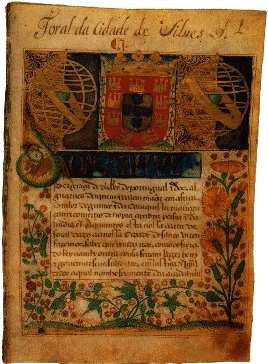
It was with the Moorish invasion which began around 714/716 that Silves became a prosperous city. By the 11th century it was the capital of the Algarve and according to some authors surpassed Lisbon in size and importance. At this time Silves was also a centre of culture, home to poets, chroniclers and lawmakers.
King Sancho I laid siege to the city in 1189. His army was aided by crusaders from Northern Europe who were on their way to the Holy Land. The fight for Silves was long and cruel. But Portuguese rule was initially short-lived and in 1191 the city was recaptured by the Moors. The definitive Christian conquest came between 1242-1249 during the reign of King Afonso III.
The centuries that followed were difficult for Silves. With the severing of its former links with North Africa and the gradual silting up of the river it found itself sidelined from the lucrative maritime trade. The coup de grâce came in 1534, with a papal bull allowing the transfer of the Episcopal see to Faro. But in the second half of the 19th century, dried fruit and above all cork breathed new life into the city.
The City
Silves retains much of its former charm in the streets of the old 'almedina', which are still laid out as they were in medieval times. The buildings that extend from the city walls to the river are, in many cases, fine examples of bourgeois architecture from the end of the 19th century and early decades of the 20th, testimony to the new prosperity brought by the cork business.
Castle
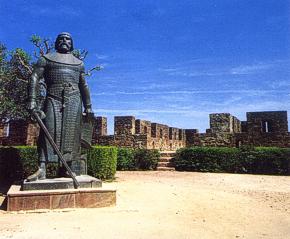
The biggest castle in the Algarve and the most beautiful military monument to the Islamic period in Portugal. It has its origins in the ramparts built around the town during the Moorish occupation, probably on the site of late Roman or Visigothic fortifications (4th/5th centuries). Its eleven towers, two of which are barbicans joined to the ramparts by a supporting arch, and thick walls enclose an area of approximately 12,000 m². The double entrance gateway is defended by two towers and the opening of the 'traitors' gate' in the north-facing walls still remains. Four of the towers have gothic doorways, vaulted halls and stones bearing the marks of medieval masons.
Sé Velha (Old Cathedral)
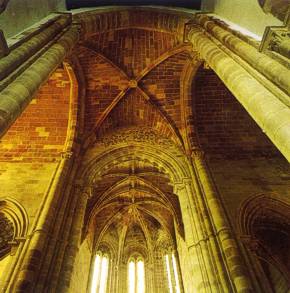
Built out of the region's fine red sandstone, possibly on the site of the old mosque, it was begun in the 2nd half of the 13th century or the beginning of the 14th. Work continued into the middle of the 15th century after part of the structure collapsed. The main facade is dominated by the Gothic doorway spanned by a backdrop which ends in a veranda held up by corbels with gargoyles. The interior consists of three naves, with plain pillars and ogival arches. The beauty of the transept and the apse makes them a good example of gothic art. On the floor are headstones, one of which denotes the former resting place of King João II (1455-1495).
Misericórdia Church
This building dates from the 16th century and its Manueline origins are apparent from a highly decorated side doorway positioned above ground level, which was possibly the former entrance to the church. The main facade has a portico of classical design. The interior consists of a single nave. The main chapel has a ribbed vault and a Renaissance retable (16th century) with paintings from a later period. The church has a collection of mercy banners still used in processions.
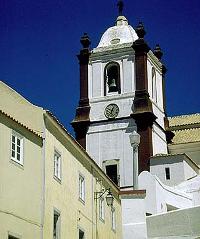
Chapel of Nossa Senhora dos Mártires
Located outside the old city walls, it was built initially in the 12th century to receive the remains of the Portuguese soldiers and crusaders who died during the first campaign to conquer Silves. It was rebuilt in the 16th century and again in the 18th. The main facade is in the baroque style while the denticulate decoration in the main chapel belongs to the Manueline period. The chapel also contains two carved and gilded altarpieces originally from the Cathedral (18th century).
Pillory
A symbol of municipal power, this stone monument has been rebuilt from 16th century remains. Commonly found in towns elsewhere in Portugal, it is the only such structure in the whole of the Algarve.
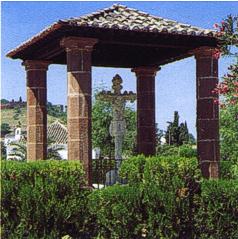
Portugal Cross
Located next to the old road that used to constitute the link with the north and with the kingdom of Portugal (whence perhaps it takes its name), the exact date of its construction is not known (15th century or beginning of the 16th century). It is one of the most beautiful crosses in Portugal and has on one side a representation of the crucifixion and on the other the Mater Dolorosa. The base dates from 1824.
City Walls
According to a description left by a crusader who took part in the conquest of Silves, the town's defences consisted, in addition to the castle, of three lines of ramparts. All that remains of these defensive walls are a few stretches built of red sandstone and taipa and a number of towers which once protected the residential area 'almedina' of Silves. Of the four gates to the almedina all that remains is the Torreão da Porta da Cidade, a barbican built in the 12th or 13th century which gives access, by way of two corridors, to the city.
Bridge over the Arade River
Dating back to the Medieval period, until only a few years ago it was this structure that connected Silves to the coast.
Municipal Museum
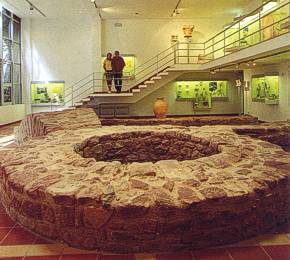
With its back to a section of the city ramparts, this building contains a well of Moorish origin (11th century) dressed with stone and taipa that is approximately 18 metres deep and 2.6 metres across. Steps lead in a spiral down to the bottom. The well was blocked up in the 16th century and the house which now contains the museum was built over it. The museum's collections include archaeological finds from throughout the municipality, including a particularly interesting collection of Moorish ceramics from digs conducted at the castle.
Places of Interest in the Municipality
São Bartolomeu de Messines
Situated in a long, fertile valley, some of São Bartolomeu's streets such as Rua do Remexido - which is spanned by an arch - retain the charm of a typical Algarve town. The poet João de Deus (1830-1896), whose reader "Cartilha Maternal" was widely used to teach reading and writing at the end of the 19th and beginning of the 20th century, was born here.
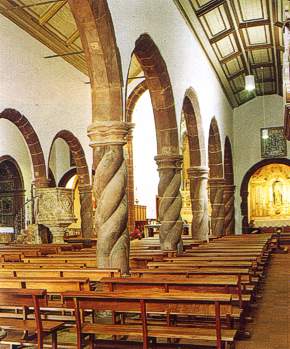
Main Church - The original church was built in the 16th century, in a transitional style between Manueline and Renaissance. To this was added at the beginning of the 18th century a baroque facade. The interior is made up of three naves with round arches supported by Solomon pillars. The two collateral chapels have ribbed Manueline vaults, while the arches of the side chapels show the influence of the later Renaissance style. There are fine gilded and carved retables and the polychrome pediments with their baroque decoration are worthy of attention. The elegant pulpit with its stone staircase is made of local marble and is a small masterpiece of baroque workmanship.
Algoz
Verdant orange, fig and almond trees surround this village which still retains a few old houses with prettily decorated chimneys and modest whitewashed hermitages.
Main Church - Displaying the architectural simplicity of the 18th century on the outside, this church has within it a number of art treasures, ranging from the 17th century tiles that cover the walls and ceiling of the baptistery to the gilded, carved retable in the rocaille style that adorns the Capela do Santíssimo.
Granary of Monte da Piedade - This building belonged to the old mutual association which would support its members with help in the form of loans. The entrance was possibly built using stonework from the 16th century. In addition to a plaque bearing the date 1704, the facade has a decorative circular window and a cross made with patterned polychrome tiles (18th century).
Hermitage of Nossa Senhora do Pilar - Sited on top of a hill, this country chapel is a good place from which to view the surrounding landscape.
Alcantarilha
With its whitewashed walls, Alcantarilha's church dominates a village of modest houses scattered prettily across the hillside.
Main Church - All that remains of the original 16th century structure is the Manueline main chapel, to which an 18th century carved and gilded retable has since been added. The baptismal chapel has tiled ashlar (17th century) and in the sacristy is a fine chest above which there is a niche decorated with acanthus leaves (18th century). Adjoining the church is a grisly Capela dos Ossos (Chapel of Bones), its walls and ceiling clad with approximately 1,500 skulls.
Misericórdia Church - Unremarkable from the outside, inside this church the statue and carved, gilded retable on the altar are worth seeing.
Pêra
In the streets around Pêra's church many of the houses are typically Algarve in appearance.
Main Church - The carved and gilded woodwork of the retables in the main chapel, the side chapels and the chapels of Nossa Senhora do Rosário and Sagrado Coração de Jesus are representative of art in the Algarve at the time (18th century). The church's holy treasures include vestments and a finely crafted silver Monstrance. The churchyard affords excellent views of the surrounding fields and the sea.
Armação de Pêra
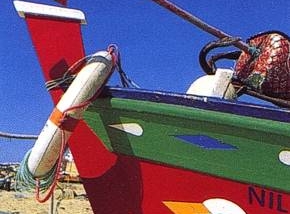
For centuries a fishing village, a focal point for fishermen attracted by the abundance of fish, especially sardines and tuna, which was salted and sold in the south and centre of Portugal. To defend the settlement against raids from pirates and corsairs, a small fort was built in the 17th century at the initiative of a prosperous boat owner. One of the walls of this old fortification with a doorway and above it the royal coat of arms still stands on a slight elevation overlooking the sea. The chapel inside, dedicated to Santo António, dates from the same period.
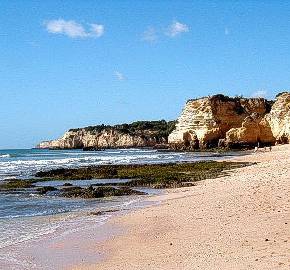
These days, the fishermen's nets are still to be seen on Praia dos Pescadores. But it is to the tourists who come for its broad sands and warm waters that Armação de Pêra now owes its lively, cosmopolitan atmosphere.
Natural Landscape
The vast triangle defined by Silves, São Bartolomeu de Messines and Armação de Pêra is a land of fruit trees and vegetable gardens, of small villages where the houses have whitewashed walls with doors and windows picked out in blue, and ornate chimneys that resemble a more solid version of lace.
A walk through this region is a chance to appreciate the glowing colours of oranges, the green foliage of almond trees, the broad crowns of carob trees and the fig trees that are often bent right to the ground.
To the north lie the hills, smooth and round as pebbles, covered with typically Mediterranean vegetation consisting of evergreen oaks, arbutus-berry trees, oaks, cistus and gorse. In a landscape of heat and light, the Arade and Funcho dams open like cool windows and the scattered white houses of villages offer welcome relief. The area as a whole is home to a variety of animal life, including approximately 80 species of nesting birds.
Practical Information
Getting There
By Car: Silves is approximately 50 km northwest of Faro. Take the A22 motorway and exit at Lagoa, then follow signs to Silves.
By Bus: Regular bus services connect Silves with Faro, Portimão, and Lagos.
By Train: Silves has a train station on the Algarve railway line.
Best Time to Visit
Silves can be visited year-round. The Medieval Festival in August brings the town's history to life with jousting, medieval markets, and traditional entertainment.