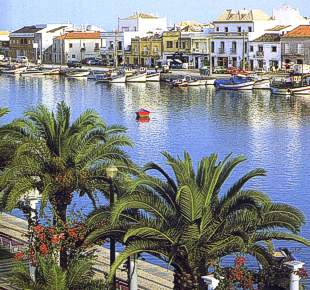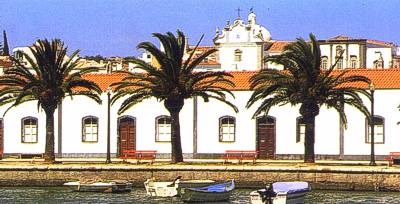
Tavira is a beautiful city of art and history, an essential port of call on any cultural tour of the Algarve. Still unspoiled by the tourist industry, it preserves a remarkable architectural heritage on both banks of the River Gilão.
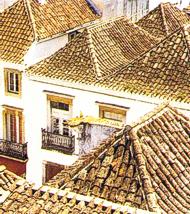
The castle and the bell towers of a multitude of churches. The river like a mirror reflecting the houses and gardens. The distinctive outline of roofs in the local "tesouro" (treasure) style. Broad vistas of sea and sand. These are among the charms of Tavira.
With 37 historic churches, Tavira boasts more religious monuments per capita than any other town in Portugal. Of all the temples, the Church of Santa Maria do Castelo is particularly interesting, with its clock tower and Gothic portal.
History
This area has been populated since Roman times, when a busy Roman road followed the coastline connecting Baesuris (Castro Marim) to Ossonoba (Faro), crossing the Gilão river at the bridge. The ancient region of Balsa lay nearby, where Roman ruins were discovered in the 19th century.
In 712, a year after Tariq invaded the Iberian Peninsula, the Moors conquered the Algarve. In the 11th century, Tabira (Tavira) was one of the main settlements of the Al-Garb, along with Santa Maria al Harum (Faro) and Silb (Silves).
During the Christian Reconquest, Tavira was taken from the Moors in 1242 by Dom Paio Peres Correia as reprisal for the treacherous murder of seven of his knights while hunting near the settlement. In 1266, D. Afonso III granted it a town charter. D. João II stayed in Tavira from June to September 1489, and it was raised to city status by D. Manuel in 1520.
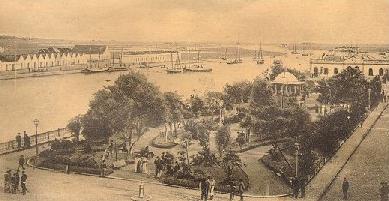
Tavira's importance during the Age of Discoveries resulted from its privileged port location — the closest to the Moroccan coast. The town prospered through fishing and maritime trade based on salted fish exports, dried fruits (almonds, figs), and wine, reaching distant ports in Italy and Flanders.
The 1755 earthquake, plague (1645-6), and the silting of the harbour led to decline. In 1766, the Marquis de Pombal founded a tapestry factory as part of his national recovery policy. In 1833, a liberal expedition headed by the Duke of Terceira landed on a beach near Tavira and began the march toward Lisbon that would overthrow D. Miguel.
Castle & Main Churches
The Castle (Castelo)
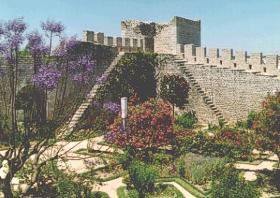
Only the walls remain, reconstructed by King Dinis in the 13th century. Originally with a trapezoidal plan and seven towers, it was probably built by the Moors on an ancient Roman castro. Among the houses, stretches of the defensive walls can still be seen, as well as the arch called Arco da Misericórdia.
Church of Santa Maria do Castelo
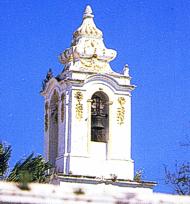
Built on the site of a former mosque in the 13th century. This is where the sons of King João I were dubbed knights after the conquest of Ceuta in North Africa. Destroyed by the 1755 earthquake and reconstructed in neoclassical style by architect Francisco Fabri, it retains its Gothic doorway with four small columns and capitals with plant designs. The facade features Gothic windows and an Arab-type window in the clock tower.
In the chancel lies the tomb of Dom Paio Peres Correia and the seven Christian knights killed by the Moors. Contains a Manueline chapel devoted to Our Lord bearing His Cross (16th century), gilded carved woodwork, decorative tiles (18th century), and valuable liturgical objects including an 18th century baroque chalice.
Chapel of Nossa Senhora da Conceição
Features an altarpiece (16th century) of the Flemish School and polychrome decorative tiles (17th century). Its origins date to 1648 when the confraternity of Nossa Senhora da Consolação was created.
Church of São José do Hospital
Contains elements from previous Gothic and Manueline adaptations. Door with "rocaille" decorations. Octagonal design with sides of unequal length. The chancel features an unusual "trompe-l'oeil" painting by Joaquim Rasquinho (1805) creating the illusion of architecture. Contains an interesting chapel with Gothic vault belonging to the Melos e Costa family, plus valuable liturgical objects.
More Churches
Church of Santo António dos Capuchos
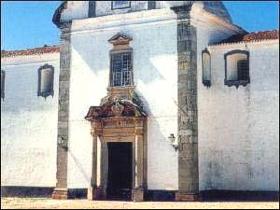
Part of a former monastery, construction began in 1612. Contains three sculptured groups representing scenes from the life of St. Anthony, frescos on the vault covering the main altar, gilded carved woodwork, and an organ with gilded carving.
Church of São Sebastião
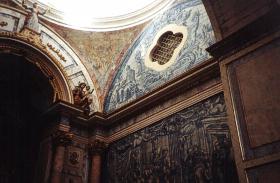
Contains a small museum of paintings with works depicting the life and martyrdom of St. Sebastian and scenes from the life of Jesus and His Mother. Features interesting Baroque decoration with "trompe-l'oeil" paintings and sixteen canvases on the walls.
Church of Nossa Senhora das Ondas
Also known as the Fishermen's Church, probably built during the reign of King Manuel I with later 18th century alterations. Connected with seafarers, it has a trapezoidal design and wooden ceiling with decorative paintings (17th century). Contains the image of Our Lady of the Waves (17th century). In the Fishermen's House next door is a precious standard of the Seafarers' Association, embroidered in gold and silver.
Church of São Paulo
Of 17th century origin with Renaissance style Galilee and portal. Features a bas relief of the Baptism of Jesus, 15th and 16th century paintings on wood in the church and sacristy, and interesting decorative tiles in the floor of the transept.
Church of Carmo
18th century church with remarkable gilded carved woodwork covering the interior. Features a cupola with clerestory and rich row of choir chairs (late 18th century).
Other Landmarks
The Roman Bridge
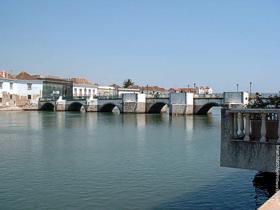
Of Roman origin, this bridge was part of the Roman road linking Faro and Mértola. It was reconstructed in the 17th century and remains the iconic symbol of Tavira, crossing the River Gilão in the heart of the city.
Town Hall (Câmara Municipal)
An impressive building with Medieval arcades. At one corner is a sculptured head of a warrior which tradition identifies as Dom Paio Peres Correia, who conquered the town from the Moors.
Fortress of São João de Tavira
A polygonal construction first built in the 17th century, expanded in the 18th century. Also known as Forte do Rato, it was built at the entrance to the Gilão river to defend the port of Tavira.
Practical Information
Location: Tavira is located on the eastern Algarve, approximately 30 km east of Faro and 20 km from the Spanish border at Vila Real de Santo António.
Getting There: Faro Airport is the nearest international airport, approximately 40 minutes by car. Tavira has a train station on the Algarve regional line with connections to Faro and Vila Real de Santo António.
Beaches: The beaches of the Ria Formosa Natural Park, including Ilha de Tavira, are accessible by ferry boat from the town. These barrier island beaches offer pristine sands sheltered from development.
Best Time to Visit: Tavira is delightful year-round. Spring brings wildflowers, while autumn offers pleasant temperatures for exploring the historic centre. The town is less crowded than the central Algarve resorts.